
There’s a moment that comes to all of us. You wake up one morning, look in the mirror, and decide today’s the day. Today you’ll finally transform your life. You’ll exercise daily, eat perfectly, write that novel, learn Spanish, meditate, and wake up at 5 AM. By noon, you’re overwhelmed. By next week, you’ve abandoned everything.
Sound familiar? You’re not broken. You’re just working against how your brain actually functions. The truth is that lasting transformation doesn’t require superhuman willpower or radical life overhauls. It requires something far more subtle and scientifically sound: Micro-habits for personal development.
These aren’t just “small habits.” They’re strategically designed behavioral shifts that leverage your brain’s natural wiring to create compound growth over time. When you understand the neuroscience behind how habits form, you’ll realize why trying to change everything at once inevitably fails—and why changing almost nothing can lead to everything when you embrace the power Micro-habits for personal development.
Your Brain’s Hidden Resistance: Understanding the Neuroscience of Change
Before we dive into strategies, you need to understand why your brain fights against big changes and embraces small ones. Three key players determine whether a habit sticks or dies: the limbic system, the prefrontal cortex, and dopamine. Together, they form an intricate system that either supports or sabotages your efforts to build effective Micro-habits for personal development.
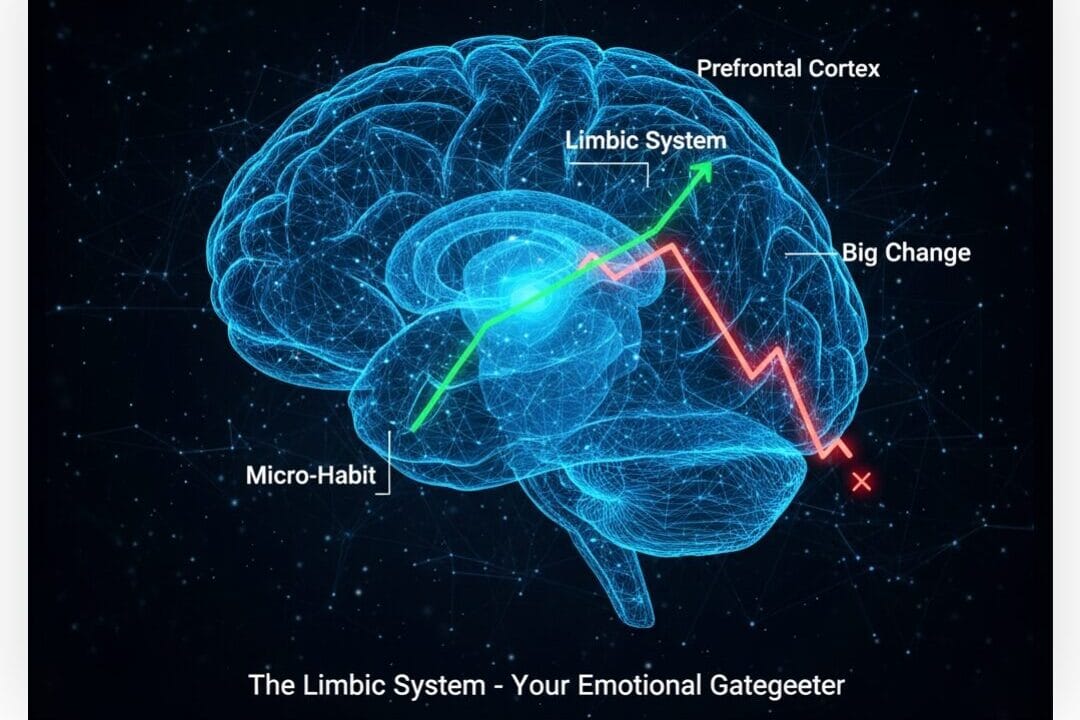
The Limbic System: Your Emotional Gatekeeper
Buried deep within your brain, beneath the wrinkled outer cortex, sits the limbic system—an ancient network that processes emotions and determines what feels safe versus threatening. This isn’t just about fear or pleasure. The limbic system evaluates every potential behavior change and asks a fundamental question: “Is this worth the risk?”
The limbic system processes emotions and experiences of reward, creating associations between actions and their outcomes. When you eat something delicious, your limbic system stamps that experience with emotional significance. When you complete a task, it notes the satisfaction. These emotional tags become the foundation for future decision-making.
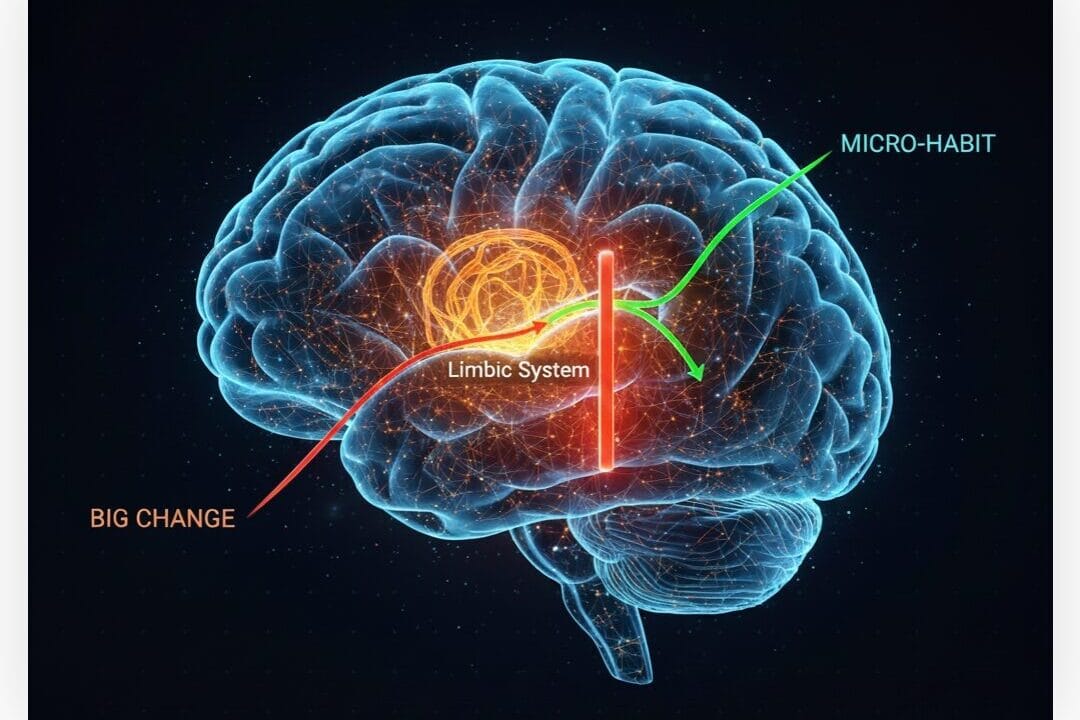
Here’s where it gets interesting for anyone pursuing Micro-habits for personal development: your limbic system creates what neuroscientists call “limbic friction”—the resistance you feel when contemplating a new behavior. Try to commit to running five miles daily when you’ve been sedentary, and your limbic system sounds alarm bells. The gap between your current reality and this ambitious goal triggers a threat response. Your emotional brain perceives danger in this massive change.
But a two-minute walk? Your limbic system barely registers it. There’s no threat, no overwhelming gap between who you are now and who you’d be after walking for 120 seconds. This is the genius of implementing Micro-habits for personal development—they slide beneath your brain’s threat detection radar.
The limbic system doesn’t just react to individual habits; it shapes your entire identity around repeated behaviors. When you consistently perform small actions as part of your Micro-habits for personal development, your emotional brain begins categorizing you differently. You’re not someone trying to become a writer—you’re someone who writes. Even if it’s just one sentence daily, the limbic system updates its model of who you are based on evidence, not aspiration.

The Prefrontal Cortex: Your Executive Decision-Maker
While the limbic system handles emotions, the prefrontal cortex manages rational thought, planning, and self-control. Located at the front of your brain, this region is what separates humans from other animals in terms of our ability to delay gratification and override impulses.
The prefrontal cortex is essential for managing executive functions including decision-making, planning, and social behavior. It’s your conscious mind deciding to change, your willpower pushing through discomfort, your planning brain scheduling tomorrow’s workout.
Research reveals something crucial about how the prefrontal cortex enables the formation of Micro-habits for personal development. Scientists have identified that specific regions within the prefrontal cortex act as supervisors for habit execution, maintaining ongoing control even after behaviors become automatic. This means habits never become completely unconscious—your executive brain maintains oversight, ready to intervene when needed.
But here’s the problem: your prefrontal cortex operates on limited resources. Every decision, every act of self-control, every moment of resisting temptation depletes what researchers call “executive function capacity.” By evening, after hundreds of Micro-decisions throughout your day, this capacity is severely diminished. This is decision fatigue—and it’s why evening resolutions fail more often than morning ones.
This is precisely why Micro-habits for personal development work so brilliantly: they require minimal executive oversight. When your commitment is two minutes of meditation rather than thirty, you’re not asking your prefrontal cortex to work overtime. Even on exhausting days when decision fatigue has depleted your resources, you still have enough executive function available for tiny actions. This is how consistency becomes possible—you’re not relying on a fluctuating resource that empties throughout the day.
Once a micro-habit becomes automatic through repetition, your prefrontal cortex can redirect its limited resources elsewhere. Deeper brain structures called the basal ganglia take over routine execution, freeing your conscious mind for more complex challenges. This is the ultimate efficiency of Micro-habits for personal development: establish the behavior when it’s tiny and manageable, then let automation handle it while you build the next micro-habit.
Dopamine: The Neurochemical Blueprint for Habit Formation
Now we arrive at dopamine—arguably the most misunderstood neurotransmitter in popular culture. It’s often called the “pleasure chemical,” but this label misses the profound role dopamine plays in learning and habit formation, particularly when it comes to establishing Micro-habits for personal development.
Dopamine release depends on neurons within the limbic system, and it can stamp our memories and habits with emotional and reward value. But here’s what most people get wrong: dopamine isn’t released when you experience pleasure. It’s released in anticipation of reward and during the pursuit of goals.
Recent neuroscience research has revolutionized our understanding of dopamine’s role in building Micro-habits for personal development. Traditionally, scientists believed dopamine functioned through what’s called “reward prediction error”—the difference between expected and actual rewards. Your brain would release dopamine when something better than expected happened, teaching you to repeat that behavior.
Dopaminergic action prediction errors serve as a value-free teaching signal, meaning dopamine doesn’t just respond to rewards but also to the actions themselves. There are different types of prediction errors: some related to rewards, others related to movement and repetition. This explains why Micro-habits for personal development work even before you see dramatic results—your brain rewards the act of showing up consistently.
When you complete a micro-habit—five push-ups, two minutes of reading, writing one sentence—your dopamine system provides reinforcement. The action itself, when repeated consistently, triggers dopaminergic responses that strengthen the neural pathways associated with that behavior. This is why consistency matters more than intensity in the context of Micro-habits for personal development. One massive workout might create a dopamine spike, but it’s followed by exhaustion and often guilt when you can’t maintain that level. Daily Micro-habits for personal development provide steady, reliable dopaminergic reinforcement.
The brilliance of this system is that it doesn’t require you to see dramatic results for your brain to mark the behavior as valuable. The simple act of following through on your commitment—however small—creates neural reinforcement. Over time, your brain begins anticipating the small dopamine release associated with your habit, making you crave the behavior itself rather than just its outcomes. This is the neurological foundation that makes Micro-habits for personal development so effective.
The Mathematics of Tiny Gains: How 1% Compounds to 3,778%
Let’s shift from biology to mathematics, because the numbers behind micro-habits for personal development are genuinely stunning. James Clear, author of “Atomic Habits,” popularized a mathematical principle that elegantly captures the power of consistent small improvements.
𝗧𝗵𝗲 𝗳𝗼𝗿𝗺𝘂𝗹𝗮 𝗶𝘀 𝗱𝗲𝗰𝗲𝗽𝘁𝗶𝘃𝗲𝗹𝘆 𝘀𝗶𝗺𝗽𝗹𝗲:
1.01^365 = 37.78
This equation demonstrates what happens when you improve by just 1% every single day for a year through consistent Micro-habits for personal development. You don’t become 365% better, as simple addition might suggest. You become approximately 38 times better. That’s the magic of exponential growth applied to human behavior.
𝗡𝗼𝘄 𝗰𝗼𝗻𝘀𝗶𝗱𝗲𝗿 𝘁𝗵𝗲 𝗶𝗻𝘃𝗲𝗿𝘀𝗲:
0.99^365 = 0.03
If you decline by 1% daily, you don’t just lose 365% over a year. You deteriorate to roughly 3% of your starting capacity. The gap between these two trajectories is staggering—the difference between thriving through Micro-habits for personal development and barely surviving.
This isn’t theoretical. These formulas represent what happens in real life when you commit to Micro-habits for personal development versus when you neglect them. That 1% improvement might be reading one page instead of zero, doing five squats instead of none, writing fifty words instead of skipping your writing session.
The difference seems trivial on day one. It’s barely noticeable on day thirty. But by day ninety, you’re starting to see changes. By day 180, others notice. By day 365, you’ve become someone fundamentally different through the compound accumulation of tiny improvements made possible by Micro-habits for personal development.
This exponential pattern explains why most people quit too early. There’s a frustrating period—Clear calls it the “valley of disappointment”—where you’re putting in consistent effort but seeing minimal results. Your Micro-habits for personal development are working beneath the surface, but the visible outcomes haven’t materialized yet. Most people quit here, assuming their efforts are pointless.
But beneath that surface, compound growth is occurring. You’re building potential energy that will eventually burst through in noticeable ways. Think of it like heating ice: the temperature rises from 25 to 31 degrees, and nothing happens. The ice remains solid. Then you hit 32 degrees, and suddenly everything changes. The accumulated heat finally crosses a threshold, and the phase transition occurs.
This is exactly what happens with consistent Micro-habits for personal development. You practice guitar for ten minutes daily, and for eight weeks, you feel stuck. Then suddenly, your fingers flow through chord progressions that felt impossible last month. The breakthrough didn’t happen because of that specific practice session—it happened because all the previous sessions reached a critical accumulation point.
Consider language learning. One intensive weekend cramming Spanish grammar won’t make you bilingual. But fifteen minutes daily for a year? That’s 91.25 hours of distributed practice, which neuroscience research shows is far more effective than massed practice. The person who crams occasionally sees minimal retention. The person who builds consistent Micro-habits for personal development achieves genuine fluency through the compound effect.
The 1% Rule also reveals why ambitious goals fail so consistently. When you try to improve by 10% or 20% daily, you’re demanding unsustainable effort. You might manage it for a few days through sheer willpower, but inevitably you’ll burn out, miss days, and eventually quit. The ambitious approach collapses under its own weight.
But 1%? That’s achievable every single day. That’s the essence of sustainable Micro-habits for personal development: sustainable improvement that compounds over time rather than explosive effort that flames out quickly.
James Clear’s Game-Changing Frameworks: Practical Implementation Strategies
Understanding the neuroscience and mathematics behind micro-habits for personal development is fascinating, but implementation is where theory becomes transformation. James Clear’s “Atomic Habits” offers two revolutionary frameworks that make consistent action not just possible, but almost inevitable for anyone building Micro-habits for personal development.
The 2-Minute Rule: Your Gateway to Consistency
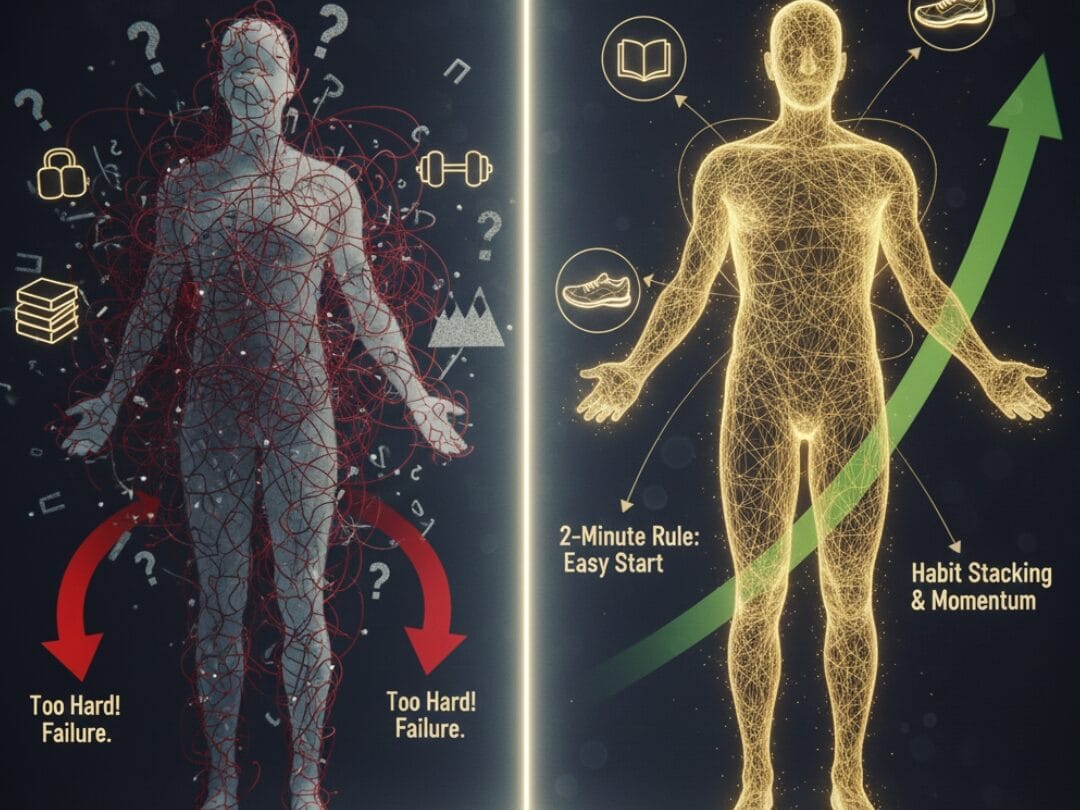
The 2-Minute Rule is brilliantly counterintuitive: when you start a new habit, it should take less than two minutes to complete. Not two minutes to warm up before the “real” habit begins—two minutes is the entire habit.
This seems absurd at first glance. How could reading for two minutes possibly matter? What will five squats accomplish? The answer lies in understanding what the 2-Minute Rule actually achieves. It’s not about the immediate outcome of those two minutes. It’s about establishing identity and removing the friction of getting started—key principles in building Micro-habits for personal development.
When starting a new habit, it should take less than two minutes to complete, and once it feels automatic and becomes part of your day-to-day routine, you can add to it. The rule recognizes a fundamental truth about human behavior: the hardest part isn’t the doing, it’s the starting. Overcoming inertia is where most behavioral change fails.
By making the habit so small that saying no feels ridiculous, you eliminate activation energy. You can’t reasonably skip two minutes of reading when you have time to scroll through social media. You can’t justify avoiding five push-ups when they take less time than brushing your teeth. This psychological trick is central to establishing successful Micro-habits for personal development.
Here’s how Micro-habits for personal development work with the 2-Minute Rule in real practice:
Want to become a reader? Your habit isn’t “read for thirty minutes” or even “finish one chapter.” It’s “read one page.” Most days, you’ll read more once you start—the momentum naturally extends the behavior. But on exhausting days when even one chapter feels impossible, you still read that single page. You maintain your identity as “someone who reads daily.”
Want to establish a meditation practice? Don’t commit to twenty minutes of transcendental stillness. Commit to sitting on your cushion for two minutes. That’s your complete habit. Some days you’ll naturally extend it. Other days, you do exactly two minutes and move on. But you never break the streak, never give your brain evidence that you’re someone who quits.
Want to become a writer? The micro-habit isn’t “write 1,000 words” or even “write for thirty minutes.” It’s “write one sentence.” By merely showing up for that habit consistently, you allow it to gradually become part of your identity. Some days that sentence becomes a paragraph, then a page. But the commitment remains one sentence—always achievable, never overwhelming. This is Micro-habits for personal development in its purest form.
The 2-Minute Rule also protects against perfectionism—the silent killer of good intentions. You can’t be perfect at something that takes only two minutes. There’s no time to optimize your approach, no room for overthinking. You just do it. This removes the psychological barrier of “I need conditions to be perfect,” which is usually code for “I’m looking for an excuse not to start.”
Critics argue this approach lacks ambition. Where’s the intensity? The commitment? But this misses the entire point. The 2-Minute Rule prioritizes automaticity over optimization. You establish the behavior pattern first, hardwire it into your daily routine through Micro-habits for personal development, and only then—after it’s genuinely automatic—do you consider scaling intensity.
Clear emphasizes staying below the point where the habit feels like work. This isn’t about limiting yourself forever. It’s about building the automation system first. You standardize before you optimize. Once the behavior is ingrained—once your brain completes it automatically—then you can gradually increase duration or intensity. But not before.
This sequencing is critical because it respects how the prefrontal cortex and basal ganglia actually form habits. Rush to intensity too quickly, and you’re asking your executive brain to maintain high effort before automation has developed. That’s a recipe for burnout and failure—the exact opposite of what effective Micro-habits for personal development aim to achieve.

Habit Stacking: Building Your Behavioral Architecture
If the 2-Minute Rule solves the problem of getting started, habit stacking solves the problem of remembering to start. This framework leverages an elegant insight: the best way to build a new habit is to attach it to one you already perform automatically—a key strategy in implementing Micro-habits for personal development.
The habit stacking formula is straightforward:
“After [CURRENT HABIT], I will [NEW HABIT]”
This leverages what psychologists call “implementation intentions”—pre-deciding exactly when and where you’ll execute a behavior. But habit stacking goes further by anchoring your new behavior to an automatic routine you already complete without thinking.
Here’s why this matters for building effective micro-habits for personal development: your brain has already carved neural pathways for existing routines. Every morning when you pour coffee, make your bed, or brush your teeth, you’re operating on autopilot. These behaviors require minimal cognitive effort because they’re deeply wired into your basal ganglia—the brain structures that handle automatic routines.
By attaching a new Micro-habit to these existing sequences, you’re essentially piggybacking on established neural infrastructure. You’re not asking your prefrontal cortex to remember a new isolated behavior. You’re linking it to something that already happens automatically, making the new behavior nearly as automatic as its trigger. This is neuroscience applied practically to Micro-habits for personal development.
Habit stacking is where you link a new habit to an existing one, like “After I brush my teeth (existing habit), I will meditate for five minutes (new habit)”. The existing habit becomes the cue for the new one, making it dramatically easier to remember and execute as part of your system of Micro-habits for personal development.
Let’s see how Micro-habits for personal development work through habit stacking:
• “After I pour my morning coffee, I will write three things I’m grateful for.”
• “After I sit down at my desk, I will close my eyes and take three deep breaths.”
• “After I finish lunch, I will walk outside for two minutes.”
• “After I brush my teeth before bed, I will lay out tomorrow’s workout clothes.”
• “After I close my laptop for the day, I will write one sentence of my novel.
“Notice the specificity. Not “in the morning” or “at some point today.” The trigger is a concrete action you already perform. This precision is crucial. Clear emphasizes that habit stacking ideally requires a cue that is highly specific and immediately actionable. Vague triggers like “after breakfast” don’t work as well because “breakfast” varies—sometimes it’s quick, sometimes leisurely, sometimes skipped entirely. But “after I put my breakfast plate in the sink” is specific and consistent. This precision matters tremendously when building Micro-habits for personal development.
The real power of habit stacking for Micro-habits for personal development emerges when you create chains. Once your first stacked habit becomes automatic, you can stack another one onto it:
“After I pour my morning coffee, I will write three gratitudes. After I write three gratitudes, I will read one page. After I read one page, I will review my daily intentions.”
Now you’ve built a morning routine of Micro-habits for personal development that takes less than ten minutes but establishes a powerful foundation for your entire day. Because each habit flows naturally into the next, they require minimal willpower or decision-making. Your brain simply executes the sequence.
This sequential approach also makes your environment work for you rather than against you. When you tie behaviors to specific contexts and previous actions, you’re essentially programming your daily life to trigger desired habits. Your coffee becomes a cue for gratitude. Your toothbrush becomes a cue for preparation. Your closed laptop becomes a cue for creativity.
These environmental and sequential triggers are infinitely more reliable than depending on motivation or willpower alone. Motivation fluctuates. Willpower depletes. But your coffee pot and toothbrush remain constant, providing daily cues for your Micro-habits for personal development regardless of how you feel.

The Identity Shift: How Micro-Habits for Personal Development Transform Who You Are
Here’s what most people misunderstand about behavioral change: it’s not about what you do, it’s about who you become. Every action you take is a vote for the type of person you want to be. And here’s the profound truth—Micro-habits for personal development cast more votes than grand gestures.
Evidence-Based Identity Transformation
When you write one sentence daily, you’re not working toward becoming a writer someday. You are a writer who writes daily. The identity isn’t aspirational—it’s factual. You have evidence. When you meditate for two minutes every morning, you’re not trying to become someone who meditates. You’re someone who meditates.
This identity-first approach is psychologically powerful because it shifts motivation from external pressure (“I should do this”) to internal alignment (“This is who I am”). And Micro-habits for personal development make this identity shift possible through consistent evidence that’s impossible to deny.
You can’t claim the identity of “marathon runner” after one ambitious five-mile run. But you can absolutely claim “someone who exercises daily” after doing ten squats every day for thirty days straight through consistent Micro-habits for personal development. The evidence is undeniable. Your self-concept adjusts accordingly, and as your identity shifts, your behavior follows naturally.
The Completion Effect: Psychological Wins That Compound
Our brains are neurologically wired to seek closure and completion. Psychologists call this the Zeigarnik Effect—the tendency to remember incomplete tasks more vividly than completed ones. When you commit to a forty-five-minute workout but quit after twenty, your brain logs this as failure. The incomplete task creates negative associations with the behavior.
But when you commit to two minutes through your system of Micro-habits for personal development and complete it? Your brain releases dopamine and marks it as success. You’ve closed the loop. Even better, if you extend beyond two minutes, you’ve exceeded your commitment—which feels even more rewarding. This creates positive feedback loops rather than cycles of guilt.
This is why Micro-habits for personal development succeed psychologically while ambitious resolutions fail. They’re designed for completion, building confidence through consistent small wins rather than eroding it through repeated failures.
Willpower Is Terrible Foundation for Change
One of the biggest misconceptions about behavioral change: it requires willpower. In reality, willpower is perhaps the worst foundation for lasting change because it’s a limited resource that depletes throughout every single day.
By evening, after hundreds of decisions and moments of self-control, your willpower reserves are empty. This explains why you’re more likely to eat poorly late at night, why evening exercise commitments fail more than morning ones, why you watch YouTube instead of working on your passion project after dinner.
Micro-habits for personal development completely bypass the willpower problem. When a habit takes two minutes, you don’t need much willpower to execute it. Even on your worst, most exhausted, emotionally drained days, you can summon enough energy for two minutes of effort. Consistency becomes possible because you’re not relying on a fluctuating resource that empties by evening. This is one of the most practical advantages of implementing Micro-habits for personal development.

The Compound Effect in Action: Real-World Transformation Through Micro-Habits
Understanding how Micro-habits for personal development compound requires thinking beyond linear progress. Most people imagine improvement as a straight line rising steadily upward. But real progress follows a different pattern—one that explains why so many people quit right before their breakthrough.
Imagine an ice cube sitting in a slowly warming room. The temperature rises from 25 to 26 degrees—nothing happens. It rises to 27, 28, 29, 30, 31 degrees—the ice remains completely solid. For six full degrees of temperature increase, you see zero change. Then the temperature hits 32 degrees, and suddenly the ice begins melting. That single degree made all the difference, but only because of the accumulated heat from all previous degrees.
This is precisely what happens with consistent Micro-habits for personal development. You practice piano for fifteen minutes daily, and for weeks you feel like you’re making no progress. Your fingers stumble over the same passages. The music sounds clumsy. Then one day—seemingly without warning—your hands flow through a piece that felt impossible last month. The breakthrough didn’t happen because of that specific practice session. It happened because accumulated practice reached a critical threshold through your daily Micro-habits for personal development.
Athletes call this phenomenon “training plateaus.” Writers call it “finding your voice.” Scientists call it “phase transitions.” But regardless of terminology, the pattern remains identical: extended periods of apparent stasis followed by sudden leaps in capability. Micro-habits for personal development keep you in the game during those frustrating plateau periods, ensuring you’re present when the breakthrough arrives.
Consider coding. The first hundred hours feel like drowning in syntax and confusion. You follow tutorials, complete exercises as part of your Micro-habits for personal development strategy, but concepts don’t click. Nothing makes intuitive sense. Then somewhere between hour 100 and 150, something fundamental shifts. Concepts that seemed impossible become obvious. You stop translating from English to code—you start thinking directly in code. The compound effect of those Micro-habits for personal development has rewired your neural architecture.
This compounding isn’t metaphorical—it’s biological. As habits become ingrained through repetition, the prefrontal cortex’s involvement diminishes. Control transfers to the basal ganglia, which solidify automatic responses. Your brain is literally restructuring itself with each repetition of your micro-habit, strengthening neural pathways and making the behavior more automatic. This is neuroplasticity in action through consistent Micro-habits for personal development.
The compound effect also explains why stopping is so damaging. When you miss a day of your micro-habit, you’re not just missing one day’s marginal improvement—you’re interrupting the entire compounding process. This is why Clear’s principle of “never miss twice” is critical for maintaining micro-habits for personal development. Missing once is human. Missing twice starts a new negative pattern. Micro-habits for personal development succeed because they’re small enough that you rarely miss even once.
Implementing Your Micro-Habits for Personal Development: A Step-by-Step System
Theory illuminates, but application transforms. Let’s translate everything we’ve covered—neuroscience, mathematics, psychology—into a concrete system you can implement starting today to build effective Micro-habits for personal development.
Step 1: Start Absurdly Smal
lThe first mistake people make: starting too big. They understand Micro-habits for personal development intellectually but can’t resist making them “worthwhile.” Resist this temptation. Your habit should feel almost embarrassingly small.
Not “exercise for twenty minutes”—do one push-up.Not”meditate for ten minutes”—sit on your cushion for sixty seconds.Not”read a chapter”—read one paragraph.
The goal isn’t the outcome of that single action. The goal is establishing the behavior pattern and building identity. Once the neural pathway is carved and your identity is forming around this behavior, you can scale up. But initially, make it so small that refusing feels absurd. This counterintuitive approach is the foundation of effective Micro-habits for personal development.
Step 2: Stack Strategically
Review your daily routine and identify behaviors you already perform automatically. These become anchors for habit stacking in your Micro-habits for personal development system. Write them down:
• Brushing teeth
• Making coffee
• Starting your car
• Sitting at your desk
• Eating lunch
• Closing your laptop
• Getting into bed
Now attach your Micro-habits for personal development to these anchors using the precise formula: “After [EXISTING HABIT],I will [MICRO-HABIT].”
Specificity matters tremendously. “After I finish brushing my teeth” works far better than “in the morning.” Your brain responds to precise triggers, not vague intentions, especially when building sustainable Micro-habits for personal development.
Step 3: Design Your Environment
Your environment dramatically impacts behavior. Every habit is triggered by environmental cues, and you’re more likely to notice cues that stand out prominently.
Want to read more? Don’t hide your book in a drawer. Place it on your pillow so you must move it to get into bed. Want to drink more water? Put a full glass on your desk first thing each morning. Want to exercise? Lay out your workout clothes the night before.
Micro-habits for personal development succeed when your environment makes desired behaviors obvious and undesired behaviors invisible. Remove friction from good habits. Add friction to bad ones. Want to waste less time on your phone? Put it in another room while working. Want to eat healthier? Put fruit at eye level and junk food in hard-to-reach cabinets. Environmental design is crucial for maintaining Micro-habits for personal development.
Step 4: Track and Celebrate
Create a simple tracking system—as basic as checkmarks on a calendar. Tracking serves three critical purposes for your Micro-habits for personal development: it reminds you to do the habit, provides visible evidence of consistency, and creates a streak you’ll be motivated to maintain.
But here’s the crucial element: celebrate your completion. Not with contradictory rewards—don’t reward healthy eating with junk food. Celebrate with acknowledgment. A fist pump. A thought of “I’m the kind of person who follows through.” This immediate positive reinforcement strengthens neural pathways and triggers dopamine release, making future repetition more likely in your journey with Micro-habits for personal development.
Step 5: Never Miss Twice
Life interrupts. You’ll get sick, travel, face emergencies. When this happens, your micro-habit might slip. That’s okay—once. The iron rule for sustaining Micro-habits for personal development: never miss twice. If you miss Monday, Tuesday becomes absolutely non-negotiable. This rule protects against the compound effect working in reverse. Missing once is a blip. Missing twice begins a new (negative) pattern.
This is where the microscopic size of Micro-habits for personal development becomes crucial. Even on your most chaotic day, you can find two minutes. You might not manage an hour-long workout during a family crisis, but you can definitely do five squats. The consistency matters infinitely more than the intensity in your system of Micro-habits for personal development.
Conclusion: The Quiet Revolution That Changes Everything
We began with a promise: that lasting transformation doesn’t require superhuman effort or dramatic overhauls. If you’ve read this far, you understand why Micro-habits for personal development work when ambitious resolutions fail.
The limbic system resists dramatic change but welcomes small steps. The prefrontal cortex can supervise Micro-habits for personal development without becoming depleted. Dopamine reinforces consistent action, carving neural pathways that become automatic. The mathematics of compound growth turns tiny improvements into exponential results. And practical frameworks like the 2-Minute Rule and habit stacking make implementation almost effortless.
Micro-habits for personal development aren’t dramatic. They won’t give you an inspiring transformation story for social media or make you the subject of viral success tales. They’re quiet, private, unglamorous. But they work. They work because they align with how your brain actually functions rather than fighting against it. They work because they respect the mathematics of exponential growth rather than demanding instant results. They work because they meet you exactly where you are.
The person you want to become isn’t waiting on the other side of some radical transformation. That person is being constructed right now, decision by decision, action by action, Micro-habit by micro-habit. Every two-minute meditation is a vote for inner peace. Every page read is a vote for knowledge. Every sentence written is a vote for creativity. These votes accumulate through consistent Micro-habits for personal development, and eventually they don’t just change what you do—they change who you are.
This is the quiet revolution of Micro-habits for personal development. No fanfare, no drama, no overnight success stories. Just consistent, patient, evidence-based action compounding into remarkable results over time. The question isn’t whether this approach works—the neuroscience and mathematics confirm it does. The question is whether you’re willing to trust the process long enough to experience it yourself through sustained Micro-habits for personal development.
Start absurdly small. Stack strategically. Track consistently. Never miss twice. And most importantly, wait with active patience. Keep showing up for your two-minute habits while the compound effect works its invisible magic beneath the surface.
The transformation you’re seeking won’t arrive with thunder. It will arrive so gradually that you won’t notice it happening—until one day you look back and realize you’ve become exactly the person your Micro-habits for personal development were quietly building all along.